No. 4 (2013): Identities and languages in the Balkan area
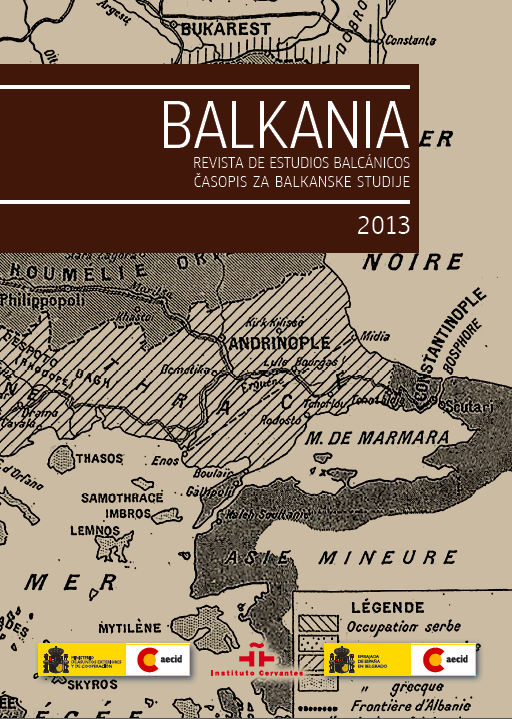
Identity is one of the questions that has sparked the most interest among Balkan scholars. Already in the times of Yugoslavia, the plurality of nations and religions implied an attractive field of study for all those who approached sociology or local anthropology. There are many reasons that have meant that this interest not only did not decrease, but rather increased in the heat of events in the area. All the supranational projects that prospered in the region (Ottoman Empire, Austro-Hungarian Empire, monarchical Yugoslavia or socialist Yugoslavia) left behind a trail of nations mired in political-social uncertainty. As a result, those nations have revealed their own adaptation and social response mechanisms, mostly linked to religion, traditions or historical narratives. The analysis of the socio-political keys of these historical episodes and their impact on Serbs, Croats, Bosnian-Muslims or Montenegrins, has allowed us to establish both continuities and discontinuities with the past, offering a prism of reactions that have revealed that nationalism or Ethnic identity are not exclusively phenomena of remote times.
Balkania in its number 4 approaches various ways of approaching identity sensu lato, given the impossibility of articulating a single common denominator at this historical moment. The objective of this issue of the magazine is to offer thematically a global perspective of this process in the different ways in which that identity is reflected (its relationship within Europe, language, politics, history or gender), and also how some of its many questions are resolved in a territory where some identities cannot be understood without the others. In general, interest in identity—like other objects of study—has been marked by the conflicts that arose in the region not so long ago. As Andrea Maura states in her magazine article: "The main argument is that the majority of works on the contemporary Balkans have been written during times of crisis." For this reason, perhaps it is now, when the area lives in a relative state of calm, that it is most worthwhile to investigate the social landscape, and offer rigorous analyses, free from the confusion and tension of political anxiety. As stated in the article, Balkan-Europe relations are a round trip, and this has its consequences on the way we look at the Balkans and, also, how the Balkans look at us.
The relationship between language and identity has been one of the most controversial aspects. The founding of new States on the basis of the majority ethnic group, or on non-consensual interethnic coexistence, has meant that language, as Francisco Villegas and Almir Methadžović analyze in their article, is: "a field of discord and dispute." The result is the interested use of identity as a tool of political struggle, but also as a means to strengthen ethnic ties. As Jairo Dorado explains in his magazine article: "through or around the standardization processes—in themselves extralinguistic processes—a linguistic identity and a basic identity community articulated on political power are created." Both articles give an account of the sociopolitical imbrications of the language, in a context of political interests where linguistic standardization has given rise to many false beliefs.
The nation-building process has also had implications for institutional design. As Aida Džanović establishes in her article in the magazine: "In Bosnia and Herzegovina, we start from the ethno-political disposition based on the institutionalization of ethnic differences." If the institutionalization of ethnic differences was crucial to agree on a model of social cohesion where democratic values were not sacrificed, the tiring Balkan transition has shown that it is essential to also advance in the consolidation of civil society. The institutionalization of ethnic nationalism can lead to political relations of collective confrontation. The result of this model is a scenario where local political demands are combined, but the imposition of political systems drawn up from the international community is also manifested. In this sense, the article by Arlinda Rrustemi and Moritz Baumgärtel focuses on the contrasts derived from the political action of Vetevëndosje in the context of globalization, analyzing a "counter-hegemonic" social movement whose approaches "do not agree with the hegemonic ideas promoted by the coloniality of power.
Gender issues have been a sensitive topic in recent decades, and are closely related to debates about identity. In her article in the magazine, Marija Grujić explains what meaning turbofolk music had among Serbs in that context: «turbofolk culture, to differentiate itself from the commercial music of the Yugoslav period, under the principle of the collective, no longer assumed any concept. regional or local community, but only a clearly Serbian, Orthodox one, at that time the most dominant and hegemonic concept of national identity. The article explores the impact of ethnic-national homogenization on gender relations in the field of turbofolk music; and how “national liberation” does not imply a break with many of the traditional and conventional legacies associated with women.
The region is undergoing the metamorphoses of a cycle change as complex as the political transition towards democracy and the entry into the EU of each of the Southeast European countries. Balkania wants to be a witness and speaker of this trajectory, and seeks to link the political phenomena that arise in the area with any European latitude, in an effort to offer an approach that does not isolate the region from the most relevant political, economic and social dynamics of the continent.
With this philosophy, Balkania maintains its commitment to in-depth analysis and cooperation between Spain and Southeast Europe. To this end, Balkania renews its website, making it more operational and updating it with new content, among which the digitization of Balkania 2003 and 2004 stands out, which will surely be of interest to readers. We hope to satisfy all of your concerns with this issue.
Miguel Rodríguez Andreu
Balkania Editor-in-chief