No. 6 (2015): Sephardic culture in the Balkans
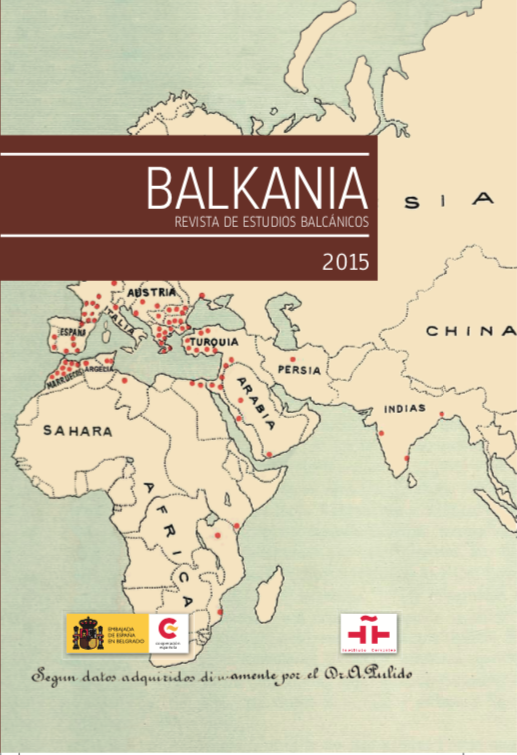
The year 1992 was a special year for all of Spain. The celebration of the Barcelona Olympics and the organization of the Seville Expo, along with the organization of the Second Ibero-American Summit, were some of the events that showed the great social, economic and cultural potential of the country that year. These celebrations were joined by commemorative events for the 500 years of the “Discovery of America”, whose date, October 12, 1492, the day of the national holiday, began, as the law that regulates it says, a “period of projection linguistic and cultural beyond European limits.
However, equally, that year the Edict of expulsion of the Jews residing in the Crown of Castile and the Crown of Aragon was signed—the Kingdom of Portugal would do so in 1496—to cause the forced exile of thousands of people who would have to be displaced to other parts of the European continent, North Africa and, later, to the American continent. Despite so many political and cultural events taking place in 1992, and of such magnitude, paradoxically, far from silencing what had been considered a “historical injustice,” a window of opportunity was opened to make visible and strengthen the ties between the Sephardic diaspora and Spain. That year the Sephardic issue would not only be of interest to the Jewish community, but it was an unparalleled opportunity for the Sephardic world to be present in academic and cultural circles with a multitude of activities and meetings that generated a great current of interest in public opinion.
An outstanding fruit of that new impulse was the creation of the Casa Sefarad-Israel, which with its activity has made it possible to highlight the Jewish legacy of Spain and bring current Sephardim closer to the homeland of their ancestors, Spain-Sepharad. As a result of this increasingly intense rapprochement, this year a new page of reunion is signed with the approval by the Congress of Deputies of a law that facilitates the conditions for obtaining nationality for all Sephardim originating in Spain, and which came into force on October. The generosity of generations and generations of Sephardim, who were custodians of Spanish traditions and customs, has its symbolic counterpart in the will of Spain to reach out to the Sephardic descendants and honor all those who nostalgically kept the keys of those which were their “original homes.”
This is not the first gesture. The memory and loyalty of the Sephardic community was recognized in 1990, when it was awarded the Prince of Asturias Award for Concord. However, since the time of Isabel II, Spain had been encouraging rapprochement with the granting of licenses to own cemeteries or permits to open synagogues. Senator Ángel Pulido, for example, saw the possibilities generated by this historical link and was seduced by the “Spaniards without a homeland”, promoting a philo-Sephardic campaign that culminated, in addition to his renowned publications, with the founding of the Spanish-Hebrew Alliance in Madrid (1910) or the opening of the Universal House of Sephardim (1920). Even when Fernando de los Ríos was Minister of State, the possibility of granting Spanish nationality to the Sephardic Jews of Morocco was considered.
Especially recognized was the role played by Spanish diplomats during World War II, who interceded with the German authorities and collaborationist governments to denounce the persecution of Jews in their Ministry and manage to grant consular protection to thousands of people of Sephardic origin, thanks to a Royal Decree of 1924 intended to grant nationality to “former Spanish protégés or descendants of these, and generally individuals belonging to families of Spanish origin.” The efforts of Ángel Sanz Briz in Budapest, Sebastián de Romero Radigales in Atenas, Bernardo Rolland de Miotta in Paris, Julio Palencia in Sofia, Javier Martínez de Bedoya in Lisbon, José Rojas in Bucharest or Eduardo Propper de Callejón in Bordeaux were decisive in saving all these lives. In this regard, it should be noted that the Ministry of Foreign Affairs and Cooperation of Spain, in collaboration with Casa Sefarad-Israel, promoted the exhibition entitled “Visas for freedom”, which was held from April 13 to May 15, 2011 in the National Bank of Serbia, in the form of recognition of the Spanish diplomats and their collaborators who during the Second World War and on their own initiative helped the Jews persecuted by Nazism. This initiative continued in May of this year through the exhibition “Images of a lost world. The life of the Sephardic Jews of the Balkans” from the Cervantes Institute in Belgrade, based on a previous exhibition by Casa Sefarad-Israel and images and texts belonging to Centropa.
Following, therefore, a trajectory of promoting Sephardic culture, which has characterized for years the cultural activities of the Spanish Embassy in Belgrade, as well as the Cervantes Institute, I am ultimately pleased to present this monograph. I would like to take this opportunity to express my gratitude to those who have made it possible: Under the direction of Miguel Rodríguez Andreu, director of Balkania magazine, this new edition has the knowledge and coordination of an expert in this field of research, professor Jelena Filipović, professor at the Faculty of Philology of the University of Belgrade, to which she is Embassy, is very grateful for all her efforts and initiative. Likewise, I would like to express my gratitude to the rest of the authors: to Krinka Vidaković-Petrov, Michael Studemund-Halévy, Ivana Vučina Simović, Katja Šmid and Ana Cirić Pavlović for trusting Balkania to share their research work, as well as to the entire team of translators, for having been part of a project that is in its sixth year and that I am pleased to see the light of day again in a year as significant as this one.
Miguel Fuertes Suarez
Ambassador of Spain in Belgrade
.....................................
Since the inauguration of the Cervantes Institute of Belgrade in December 2004, the center has been integrated into the cultural life of the city. This was its objective, and this is what it has been, always at the service of the language and culture of all the countries that share the Spanish language, as well as at the service of the citizens who have sought to get closer to our institution and the activities that we organize and in which we have participated since then.
One of the cultural activities in which the institution has collaborated since 2010 is the publication of the Balkan studies magazine Balkania, whose presentations year after year have been held in our facilities, bringing together a large number of attendees and personalities from the social, cultural and political life of the city. The presence of Spanish and Serbian experts at these meetings has aroused the interest of the local media, which has recognized the publication's efforts to strengthen ties between both geographies, and also to provide knowledge about a territory that has much to discover.
This year the journal dedicates its contents to Sephardic culture, whose community until the Second World War was very numerous in the area. Cities such as Thessaloniki, Sarajevo, Istanbul and Belgrade during the Ottoman Empire were a “new home” for the thousands of Sephardic Jews who, expelled from the Iberian Peninsula after the Edict of Expulsion of 1492, arrived in these territories. For centuries they were guardians and protectors of customs and an ancestral heritage, among which are the Spanish language and culture. This is reflected in the enormous current interest in Spain and Latin America throughout the region, as well as in the Sephardic legacy.
It is not surprising then that the Cervantes Institute of Belgrade plays a relevant role in the visibility and promotion of this historical and emotional link, and has close contact with the Sephardic community in Belgrade, in Serbia and throughout the region. This year with even more reason, due to the approval of the law that facilitates the conditions for obtaining Spanish nationality for the population of Sephardic origin. In this sense, the Cervantes Institute is responsible for the two necessary tests in this regard: that of knowledge of Spanish with the Spanish diploma DELE level A2 or higher and that which accredits knowledge of the Constitution and the Spanish social and cultural reality CCSE, of which you can find exhaustive information on our website.
In this way, a trajectory is maintained that, since the first activity we organized in 2006, has been based on the spirit of promoting and making Sephardic culture visible with activities and meetings in the Serbian capital such as: exhibitions, music concerts, poetry contests, screening of documentaries (The Last Sephardic and The Angel of Budapest) or, more recently, the organization of the exhibition “Images of a Lost World. The Life of the Sephardic Jews of the Balkans”, currently available for those institutions interested in its exhibition.
It is in this context of action and collaboration, where the Cervantes Institute of Belgrade did not hesitate to offer all its help to the director of the journal Balkania, Miguel Rodríguez Andreu, and to the coordinator of this issue, the professor in Sociolinguistics and expert in Sephardic culture , Jelena Filipović, in the editing, promotion and distribution of this monograph. That is why I am pleased to be able to affirm that Balkania does nothing but provide quality content, as it has been doing since its foundation, and, in addition, adds efforts to a task that from the center that I represent has always been considered capital in our proposal and agenda. cultural for the city of Belgrade.
Enrique Camacho García
Director of the Cervantes Institute of Belgrade